Who Is a Good Candidate for MTF Breast Augmentation? A Self-Check
A simple MTF breast augmentation eligibility checklist featuring health requirements, realistic expectations, smoking status, recovery readiness and follow-up planning, with a calendar and stationery on a clean desk.
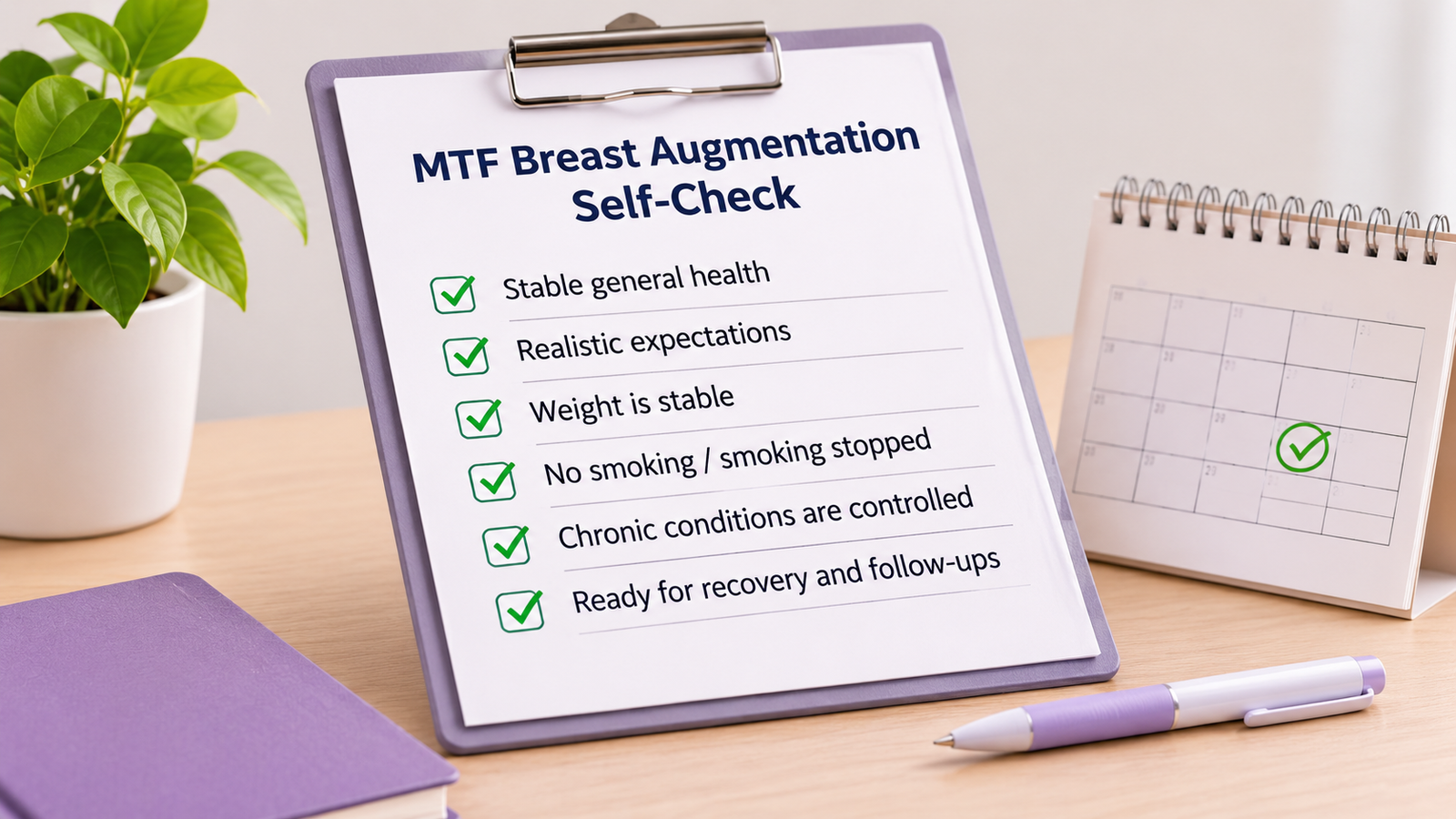
A good candidate for MTF breast augmentation is generally in stable health, has realistic expectations, and wants to increase breast volume through gender-affirming surgery. Conditions such as uncontrolled diabetes, high blood pressure, nicotine use, or significant recent weight changes may require attention first. A consultation with a qualified surgeon helps confirm individual suitability.
For transgender women and other transfeminine individuals, breast augmentation can help create a chest appearance that better aligns with personal goals. However, surgery is an individual choice, and not everyone needs or wants it.
If you are wondering who can get MTF breast augmentation, this guide explains eligibility, medical considerations, preoperative tests, and realistic expectations.
Key Takeaways
- Suitable candidates generally have stable health and understand the benefits and limitations of surgery.
- Breast augmentation can be considered whether or not hormone therapy has produced the desired breast development.
- Diabetes, hypertension, and nicotine use require individual risk assessment.
- Age, weight stability and existing breast tissue influence surgical planning.
- A consultation with Dr. Ashutosh Shah can help determine whether surgery is appropriate.
Who Usually Benefits Most?
MTF breast augmentation is a gender-affirming procedure designed to increase breast volume and improve chest contour.
It may benefit transgender women and other transfeminine adults who want additional breast development beyond their existing appearance.
Some individuals experience breast growth with feminising hormone therapy, while others develop relatively limited volume. The amount of growth varies between individuals.
For those seeking additional volume, surgery may be an option.
The guide to breast augmentation for trans women explains the procedure and available considerations.
Who may be a suitable candidate?
A suitable candidate generally:
- Wants breast augmentation for personal, well-considered reasons.
- Has sufficiently stable general health for elective surgery.
- Understands that breast implants have limitations and potential complications.
- Has realistic expectations about breast size, shape and symmetry.
- Can follow postoperative care instructions.
- Is prepared to attend recommended follow-up appointments.
Hormone therapy is not necessarily a universal requirement for breast augmentation. Eligibility should be assessed individually using current clinical guidance and the patient's circumstances.
Does existing breast size matter?
Existing breast tissue, chest width, skin elasticity and body proportions influence implant selection.
Someone with limited breast tissue may need a different surgical plan from someone with more developed breasts.
Therefore, implant size should not be chosen only from photographs or personal preference.
A surgeon must consider what is anatomically appropriate and safe.
Who Should Wait or Avoid It for Now?
Not every patient is ready for surgery immediately.
Certain health conditions or lifestyle factors can increase the likelihood of complications.
In some cases, postponing surgery allows time to improve health and reduce avoidable risks.
Uncontrolled diabetes
Poorly controlled blood sugar can increase the risk of infection and wound-healing problems.
Patients with diabetes may still be eligible for surgery, but their condition should be assessed and optimised beforehand.
The treating team may review recent blood sugar results and HbA1c.
[Dr. Ashutosh Shah to confirm any clinic-specific preoperative criteria.]
Uncontrolled high blood pressure
High blood pressure that is not adequately managed may increase perioperative risks.
Patients should continue prescribed treatment and obtain appropriate medical assessment.
The surgeon and anaesthesia team can determine whether additional evaluation is necessary.
Smoking and nicotine exposure
Smoking and nicotine use can interfere with blood circulation and wound healing.
Patients may be advised to stop smoking, vaping, and other nicotine products before and after surgery.
The required cessation period should be confirmed with the surgical team.
Active infection or significant medical illness
An active infection, unstable heart or lung disease, or another serious medical condition may require treatment before elective surgery.
The surgeon may recommend postponement until the condition is adequately managed.
Unclear expectations
Surgery may also need to be delayed if a patient has not yet understood the likely results, scars, risks or long-term responsibilities associated with implants.
Taking additional time for counselling and informed decision-making can be helpful.
How Do Age, Weight and Health Conditions Matter?
Several individual factors influence MTF breast augmentation eligibility.
Age and informed consent
Gender-affirming breast augmentation is commonly considered for adults who can provide informed consent.
For people under 18, eligibility is more complex and depends on applicable law, specialist assessment and relevant clinical guidance.
There is no single upper age limit. Instead, overall health, anaesthesia risk and individual goals are important.
Weight stability
Significant weight changes may alter breast volume, skin elasticity and body proportions.
Therefore, patients planning substantial weight loss may benefit from discussing the timing of surgery.
However, there is no universal body weight or BMI that determines eligibility for everyone.
Existing medical conditions
Diabetes, hypertension, clotting disorders and cardiovascular conditions may affect surgical planning.
Patients should disclose their full medical history, including previous surgery, medications and allergies.
Hormone therapy
Feminising hormone therapy can influence existing breast development and body composition.
However, patients should not stop hormone treatment without advice from their prescribing clinician and surgical team.
Other body-contouring goals
Some patients considering breast augmentation also explore procedures such as hip augmentation surgery.
These are separate treatments with different indications, risks and recovery requirements.
Combining procedures is not automatically advisable and requires an individual safety assessment.
MTF Breast Augmentation in Vesu Surat: Eligibility Self-Check
Patients researching MTF breast augmentation in vesu surat can use the following checklist to prepare for a consultation.
This is a discussion tool, not a medical eligibility test.
MTF Breast Augmentation Self-Check Table
| Question | Yes / No | Discuss With Doctor |
|---|---|---|
| Am I in stable general health? | ☐ Yes ☐ No | Medical history and current conditions |
| Do I understand my surgical goals? | ☐ Yes ☐ No | Desired breast shape and volume |
| Is my weight relatively stable? | ☐ Yes ☐ No | Planned weight changes |
| Is my diabetes controlled, if applicable? | ☐ Yes ☐ No | Blood sugar and HbA1c |
| Is my blood pressure managed? | ☐ Yes ☐ No | Medication and medical clearance |
| Do I smoke or use nicotine? | ☐ Yes ☐ No | Cessation support and timing |
| Do I understand implant-related risks? | ☐ Yes ☐ No | Rupture, contracture and future surgery |
| Can I arrange recovery support? | ☐ Yes ☐ No | Transport, rest and assistance |
| Can I attend follow-up visits? | ☐ Yes ☐ No | Postoperative monitoring |
| Have I considered future body changes? | ☐ Yes ☐ No | Weight changes and breast appearance |
Important: A “No” answer does not automatically mean surgery is unsuitable. Likewise, answering “Yes” to every question does not guarantee eligibility.
Dr. Ashutosh Shah can review the answers alongside a clinical examination and relevant investigations.
What Tests Are Done Before Treatment?
Before breast augmentation, the surgeon may recommend investigations based on the patient's age, medical history and surgical requirements.
Medical history assessment
The consultation usually includes questions about:
- Previous medical conditions and operations.
- Current prescription medicines and supplements.
- Hormone therapy and relevant treatment history.
- Smoking, vaping and nicotine use.
- Allergies and previous anaesthesia problems.
- Personal or family history of blood clots.
Blood tests
Blood tests may be recommended to assess general health and identify concerns that could affect surgery.
Patients with diabetes may require blood glucose and HbA1c assessment.
Other investigations depend on individual medical needs.
Breast and chest examination
The surgeon evaluates chest width, breast tissue, skin characteristics and symmetry.
Breast imaging may be recommended when clinically indicated based on symptoms, age, risk factors or screening guidance.
Anaesthesia evaluation
The anaesthesia team assesses medical fitness and discusses any additional precautions.
Patients should also ask about the expected hospital stay and postoperative support.
[Gender Wellness to confirm its usual preoperative assessment protocol.]
What Are Realistic Expectations?
Breast augmentation can increase breast volume and change chest contour. However, the results depend on anatomy, implant selection and healing.
Breast size and symmetry
The surgeon can recommend implant options that suit the patient's chest dimensions.
Perfect symmetry cannot be guaranteed because natural anatomical differences may remain.
Scars and sensation
Breast augmentation involves incisions and therefore produces scars.
Temporary or persistent changes in breast or nipple sensation may occur.
Patients should discuss the expected scar location and sensory risks before surgery.
Implant lifespan
Breast implants are not lifetime devices.
Future imaging, replacement, or additional surgery may be necessary because of rupture, capsular contracture, changes in appearance, or other complications.
Breast lift considerations
Some patients may also ask whether a breast lift is necessary to address skin laxity or breast position.
A lift is a separate procedure and is not required for every augmentation patient.
The article on breast lift surgery provides additional background.
Emotional expectations
Breast augmentation may help patients achieve a desired physical appearance, but it cannot guarantee a particular emotional or social outcome.
A supportive consultation should allow patients to discuss their goals without pressure.
Conclusion
Understanding who can get MTF breast augmentation involves more than age or desired breast size.
Stable health, realistic expectations, informed consent, and the ability to follow postoperative care instructions are important considerations.
Conditions such as diabetes, high blood pressure, and nicotine use may require additional assessment, but they do not always prevent surgery.
At Gender Wellness, Dr. Ashutosh Shah can discuss individual suitability, surgical options and expected recovery.
To enquire about an assessment, contact Gender Wellness.