Hair Transplant for Transgender Patients, Hairline Feminization and Beard Restoration
A warm, simple guide to hair transplant for transgender patients, covering hairline feminization for trans women and beard restoration for trans men using the gentle FUE method.
Hair frames the face, and people read a lot from it before you say a word. A high or receding hairline can feel jarringly masculine to many trans women, out of step with who they are. For plenty of trans men, the opposite problem stings just as much: a thin or patchy beard that never quite fills in. Hair transplant for transgender patients addresses both, and the shift it brings can be quietly life affirming.
At Elegance Transgender Clinic in Surat, Dr. Ashutosh Shah relies on modern, precise techniques to move your own hair to where you want it. The hair is yours, so it looks like it belongs and keeps growing for years. What follows is a plain explanation of how the work is done, who it tends to suit, and what recovery actually feels like day to day.
Key Takeaways
- Hair transplant for transgender patients moves your own hair to build a feminine hairline or a fuller beard.
- The FUE method takes single hair groups one by one, so it leaves no long scar.
- Trans women often choose hairline lowering and softer, rounder corners for feminization.
- Trans men often choose beard restoration to add density to the cheeks, jaw, chin, and moustache.
- Transplanted hair sheds first, then regrows steadily, with full results in about nine to twelve months.
- Local centres in Adajan and Vesu make follow up visits easy for patients across Surat.
What is a hair transplant for transgender patients?
A hair transplant for transgender patients takes healthy hair from the back of the scalp and places it where you need more. Trans women use it to lower and feminize the hairline, while trans men use it to build a beard. Since the hair is your own, it looks natural and lasts.
The donor zone at the back and sides of the head behaves differently from the rest. Those roots shrug off the hormones that thin hair elsewhere, so once they are relocated they tend to keep growing. The new hairline or beard then acts like ordinary hair. Wash it, trim it, style it, exactly as you treat everything else on your head.
FUE hair transplant: a method where each tiny group of hairs (a follicular unit) is removed one at a time and placed into the new area, leaving only small dots that fade.
This is closer to an art than a routine procedure. Angle, direction, and density all have to match the area being treated. A feminine hairline calls for soft, irregular edges; a beard needs hairs that fan outward the way real facial hair does. Planning and a steady artistic eye carry as much weight here as surgical skill.
How does hairline feminization work for trans women?
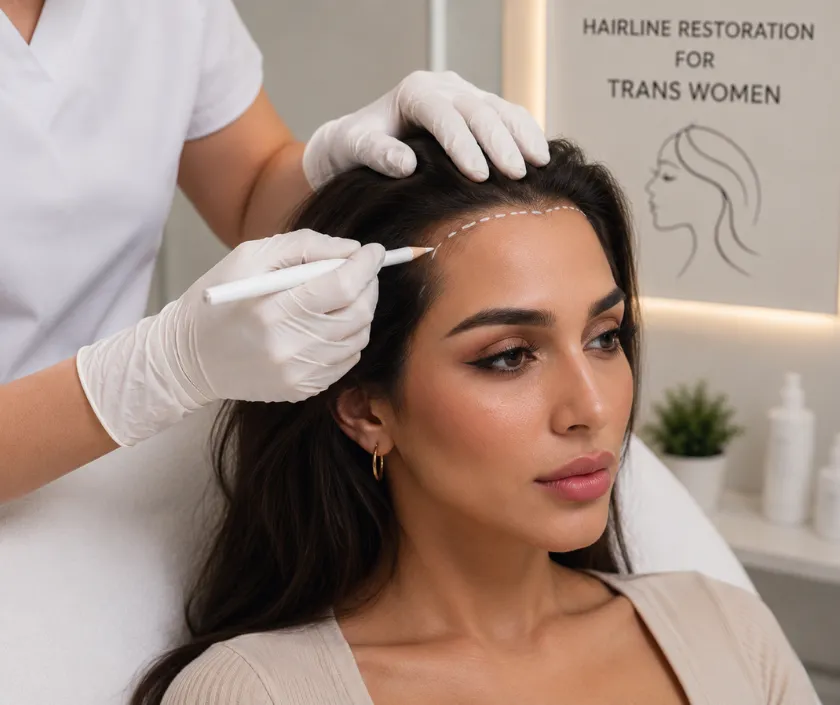
Hairline feminization reshapes a high or M shaped hairline into a rounder, lower frame that suits a softer face. Surgeons fill the temple corners and bring the front edge down, then add fine single hairs along the border. Together, these touches soften the forehead and balance the whole face.
Male hairlines tend to sit higher and carve sharp recessions at the temples. A feminine hairline does the reverse: lower, gently curved, none of those deep corners. To build it, Dr. Ashutosh Shah looks at your forehead height, the shape of your face, and what you are hoping for, then draws the new border by hand.
Hairline lowering and rounding
Hairline lowering moves the front edge closer to the brows, which shortens a tall forehead. Rounding then removes the angular corners that read as masculine. Used together, these two steps create the smooth, oval frame that many trans women want, and the result stays in proportion so it never looks pasted on.
Soft, natural front edges
The very front row is what decides whether a hairline looks real or obviously done. The surgeon places single, fine hairs in a slightly uneven pattern there, mimicking the small irregularities nature leaves behind. Behind that row, hairs sit more densely for fullness. Fine in front, fuller behind: that contrast is what sells a believable feminine finish.
If you are weighing other facial changes too, hairline work sits neatly alongside surgical reshaping. Many patients pair it with our facial feminization and transformation procedures for a more harmonious overall result. There is also a fuller explanation in our guide to what facial feminization surgery involves.
How does beard restoration work for trans men?
Beard restoration adds your own scalp hair to the cheeks, jaw, chin, and upper lip to create a fuller beard. The surgeon places each hair at a low, natural angle so it grows outward like real facial hair. Over the months that follow, the beard thickens and can be shaved or shaped freely.
Testosterone pushes facial hair growth for many trans men, but the result is often patchy or slow to arrive. A transplant fills those gaps and builds density that hormones alone may never reach. The transplanted hairs come from your scalp, so they keep growing, which means a regular trim becomes part of the routine.
Building density on cheeks and jaw
Sparse cheeks and a thin jawline come up again and again, and both respond well to restoration. The surgeon lays new hairs in the direction your beard naturally falls, blending them with whatever growth is already there. The beard then reads as even and connected rather than spotty.
Moustache and chin shaping
The moustache and chin anchor the lower face and send a clear masculine signal. Hairs here have to sit at a sharp downward angle to look right. With careful placement, the moustache fills in and the chin gains the strength many trans men are after. From there it is yours to grow, trim, or sculpt however you like.
What is the FUE method and why is it used?
FUE, or follicular unit extraction, removes hair in tiny single groups instead of a long strip. Each group is harvested with a small punch, then placed one by one into the new area. Because the openings are so small, FUE leaves no long scar and heals quickly, which makes it ideal for transgender hair work.
The older strip method removed a band of skin from the back of the head and left a line that could peek through short hair. FUE sidesteps that completely. It scatters tiny dots instead, and they fade within weeks, so cropped hair is no longer a worry. For beard work the precision matters even more, since every facial hair has to land at an exact angle.
- No long scar: only small, fading dots remain in the donor area.
- Natural angles: each hair is set to match how hair grows in that spot.
- Faster healing: the small openings close quickly, so downtime stays short.
- Flexible styling: you can keep your hair or beard short afterwards.
For dependable general health information about hair loss and treatments, you might also read NHS guidance alongside advice from your own surgeon.
What does healing and recovery look like?
Healing after a hair transplant is usually mild and steady. Tiny scabs form around each new hair and fall off within one to two weeks. Some redness and slight swelling are normal at first, yet most people return to gentle daily life within a few days. Full, settled results appear over nine to twelve months.
One stage catches people off guard. A few weeks in, the transplanted hairs shed. This is expected, not a failure. The roots stay safely in place and soon push out new, permanent hairs. Sitting through this quiet phase pays off, because the regrowth that follows is the real result you came for.
The first two weeks
Early on, the job is to protect the new grafts and keep the area clean. Your surgeon gives simple washing instructions and may suggest sleeping with your head slightly raised. You steer clear of heavy exercise, direct sun, and anything that rubs the treated area. Careful handling now protects the growth still to come.
Months three to twelve
Once the shedding settles, new hairs start showing around month three or four. Growth then builds steadily, adding length and thickness week by week. By roughly the one year mark, the hairline or beard reaches its full look. At Elegance Transgender Clinic, we check in at each stage so you always know what is coming next.
Who is a good candidate?
Good candidates have enough healthy donor hair at the back and sides of the scalp and realistic goals. Stable general health helps too. Trans men often do best once hormone therapy has settled their natural facial hair, so the new growth can be planned around it. A consultation confirms what suits you.
Surgery on day one is not always the answer. Sometimes softer non surgical options, or simply better timing, make more sense first. If you would rather try lighter steps before or alongside a transplant, our non surgical aesthetic treatments can sit comfortably within your plan. The right path comes down to your face, your hair, and your goals, which is exactly what a private assessment is for.
Patients in Surat appreciate how close our care stays. With centres in Adajan and Vesu, follow up visits are quick and near home. That proximity lets us watch your progress closely and adjust as the new hair fills in.
Ready to talk about your hairline or beard?
If a feminine hairline or a fuller beard would help you feel more like yourself, we are here to listen, with warmth and no judgement at all. Dr. Ashutosh Shah and the team at Elegance Transgender Clinic in Surat will talk you through every option in plain language. When you are ready, arrange a private consultation with our team and take the first step toward the reflection you have been waiting to see.