Does Gender Transition Solve Everything? What It Changes, and What It Does Not
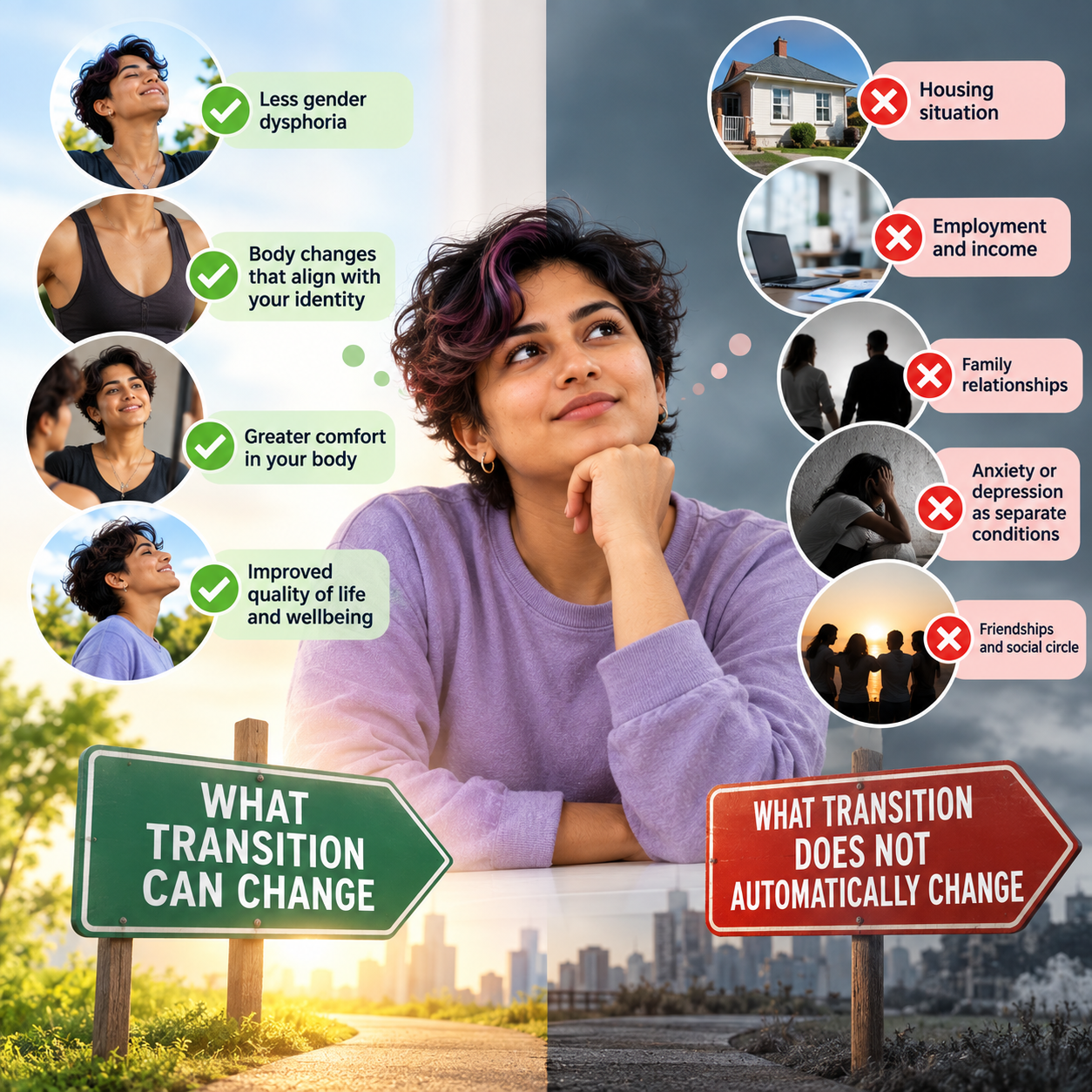
Gender transition can substantially reduce gender dysphoria, but it does not automatically resolve every difficulty in a person's life. Housing, employment, family relationships, anxiety and depression are separate problems that need their own support. Expecting transition to solve them all sets up disappointment that is avoidable with honest preparation.
Written by Dr. Ashutosh A Shah, M.B.B.S., M.S., M.Ch., D.N.B., Board Certified Plastic Surgeon, Elegance Transgender Clinic, Surat. Reg. no. [REG NO]. 22+ years in plastic and reconstructive surgery.
Medically reviewed by Dr. Ashutosh A Shah · Published 30 September 2026 · Last reviewed 30 September 2026
Gender transition can substantially reduce gender dysphoria, but it does not automatically resolve every difficulty in a person's life. Housing, employment, family relationships, anxiety and depression are separate problems that need their own support. Expecting transition to solve them all sets up disappointment that is avoidable with honest preparation.
This page is not an argument for waiting, and it is not a list of reasons to be cautious. Gender affirming care works, the evidence for that is strong, and the next section says so before anything else.
It is about something narrower and more useful: what this treatment is for, what it is not for, and why the difference is worth knowing in advance rather than discovering at six months.
What does gender transition actually change?
It changes the thing it is designed to change: the distress caused by a mismatch between how you experience your gender and the sex you were registered as at birth. The evidence that it does this well is not marginal.
The World Professional Association for Transgender Health Standards of Care, version 8 states it plainly: "There is strong evidence demonstrating the benefits in quality of life and well-being of gender-affirming treatments, including endocrine and surgical procedures".
That sentence deserves to be read before any of the qualifications on this page. It is the finding of the field's own guideline, and it is not hedged.
WPATH describes the purpose of the whole framework as helping trans and gender diverse people, who it refers to as TGD people, reach "lasting personal comfort with their gendered selves". Comfort is a modest-sounding word for what it describes, and it is the right one. The aim is to stop a daily friction, not to deliver a transformed life.
What follows from that is the entire argument of this page. A treatment that is very good at what it targets is still only aimed at what it targets.
Why does transition help with gender dysphoria specifically?
Because gender dysphoria is caused by the mismatch, and transition reduces the mismatch. The mechanism is direct, which is why the effect is reliable.
The NHS defines the two terms separately, and the distinction matters: "The feeling of your gender identity being different to your sex registered at birth is known as gender incongruence." Dysphoria is what happens when that incongruence causes distress. The NHS describes it as being "distressed or uncomfortable for a long time" as a result.
So there are two things, and only one of them is a problem. Incongruence is a description. Dysphoria is the distress it produces in some people. Gender affirming care works on the incongruence, and the distress falls as a consequence.
This also explains why the effect does not extend further. Nothing in that mechanism touches your rent, your job, your family's reaction or a depression that predates all of it. Those are not made of incongruence.
What does transition not change on its own?
Everything that was already a separate problem. Money, housing, work, education, family relationships, friendships, and any mental health condition that exists in its own right will all still be there afterwards, and will need their own attention.
The ones people most often expect to resolve by themselves:
- A difficult family. Relationships change after transition, sometimes for the better and sometimes not, but the change follows from how the family responds rather than from the treatment.
- Work and income. Discrimination at work is a structural problem. Transition does not address it and can, in some workplaces, make it more visible.
- Depression or anxiety that has been there for years. These may ease as dysphoria reduces. They may not. They are conditions with their own treatments.
- Loneliness. A more comfortable body does not build a social circle. That is a separate piece of work, and the question of who should be around you is covered further down.
- How you feel about your appearance in general. Gender affirming care addresses gender related distress. It is not a treatment for dissatisfaction with appearance more broadly.
- Confidence. Often improves, and for some people markedly. But it improves as a result of living more comfortably over time, not as an outcome of a procedure.
None of this is an argument against transition. It is the same sentence you would write about any effective treatment: it does what it does, and other things need their own help.
Why do some people feel low after reaching a goal they waited years for?
Because a goal that shaped several years of your life is suddenly behind you, and that is disorienting even when the outcome is exactly what you wanted. This is common, it is widely reported, and it is not regret.
It is worth naming because people who feel it and find nothing about it anywhere conclude that something has gone wrong with them. Usually what has happened is ordinary:
- The organising goal is gone. Waiting, saving, researching and planning took up real space. When they stop, the space does not fill itself immediately.
- Recovery is physically demanding, and low mood during a demanding recovery is not a verdict on the decision that led to it.
- The change takes time to feel ordinary. There is usually a period where the result is right but does not yet feel like simply your body. That passes.
- Anticipation set a very high bar. Years of imagining a moment is a lot of weight for any single moment to carry.
- Everything else is still there. If the separate difficulties listed earlier were waiting, this is when they become visible again, and it can feel like the treatment failed when in fact it did its job and the other problems did not go anywhere.
Tell your team if you feel this way rather than sitting with it. It is expected, they will have heard it many times, and it does not mean anything about your decision. If low mood persists, the NHS notes that adults "can refer yourself to an NHS talking therapies service for certain mental health conditions such as depression or anxiety", and in India the equivalent route is a GP or a mental health professional directly.
What does the evidence say about wellbeing after gender affirming care?
That it improves quality of life and wellbeing, and that the evidence for this is described by the field's own guideline as strong. That is the headline and it should not be buried under caveats.
Two things follow from how WPATH words it that are worth drawing out.
First, the benefit is not limited to one intervention. The guideline refers to gender affirming treatments "including endocrine and surgical procedures", which covers a range rather than a single operation. It also states that "there is no 'one-size-fits-all' approach and TGD people may need to undergo all, some, or none of these interventions". Some people need surgery. Some need hormones. Some need neither, and that is a complete and legitimate pathway rather than an incomplete one.
Second, the framework is explicit that being trans is not an illness. WPATH states that gender expression not stereotypically associated with sex registered at birth is "a common and a culturally diverse human phenomenon that should not be seen as inherently negative or pathological", and that "Gender incongruence is no longer seen as pathological or a mental disorder in the world health community".
That second point belongs on a page that discusses mental health alongside transition, because otherwise the two ideas bleed into each other. Talking about depression and transition in the same article does not make the second a form of the first.
Which difficulties need their own support rather than more treatment?
Anything that would still be a problem for someone who was not trans. That is a rough test and it works surprisingly well for deciding where to take a difficulty.
| What you are dealing with | Does transition address it | Where it should go |
|---|---|---|
| Distress about a mismatch between body and gender | Yes, directly | Gender affirming care |
| Depression or anxiety as a condition in its own right | Not on its own | A GP or mental health professional, alongside transition |
| Family rejecting or not accepting you | No | Peer support, community, and where appropriate family counselling |
| Discrimination at work or in housing | No | Legal advice and advocacy organisations |
| Money and the cost of treatment | No | Planned in advance with the clinic, before starting |
| Isolation and having nobody to talk to | Indirectly at best | Community and peer support networks |
| Uncertainty about what you want from treatment | Partly, through assessment | The assessment conversation, which is what it is for |
Notice that most rows point somewhere other than a clinic. That is not the clinic declining responsibility. It is the difference between a treatment and a life, and a clinic that claimed to fix the whole table would be overselling.
Why is the assessment before treatment not a gatekeeping exercise?
Because its purpose is to establish what you want and that you understand it, not to decide whether you are trans enough to deserve it. WPATH describes the assessment as "part of a patient-centered approach", and is explicit that therapy is not a hurdle to clear.
The guideline states: "Psychotherapy may be beneficial but should not be a requirement for gender-affirming treatment, and conversion treatment should not be offered." Both halves of that sentence matter. Support should be available and should not be compulsory, and any approach aimed at changing a person's gender identity is rejected outright. WPATH puts the second point as a direct instruction to clinicians: "Reject approaches that have the goal or effect of conversion and avoid providing any direct or indirect support for such approaches or services."
What an assessment is actually establishing:
- What you are hoping for, which is where an expectation that transition will fix everything should surface, and be discussed rather than left to be discovered later.
- That you understand what each intervention does and does not do, including which effects are permanent.
- That you can consent, which is a legal standard and not a judgement about your identity.
- That other health conditions are being managed, because they affect anaesthesia, healing and hormone safety. This is the same question anyone has before any surgery.
- What support you have, which is practical planning rather than a test.
If an assessment feels like an interrogation, that is a problem with how it is being conducted rather than with the idea of assessment. You are entitled to ask what each question is for.
What does a realistic expectation look like at each stage?
Roughly this: the medical timeline and the social timeline do not move at the same speed, and most of the disappointment people describe comes from expecting them to.
| Stage | What usually changes | What usually does not, yet | When to reassess |
|---|---|---|---|
| Deciding and being assessed | Relief at having a plan and a direction | Anything about the body, and nothing about family or work | After the first appointment, not before |
| First months of treatment | Early physical changes begin, often subtly | How other people read you, which lags well behind | Six months, not six weeks |
| Six to twelve months | Changes become visible to you and to others | Family adjustment, work situation, old friendships | Twelve months |
| After surgery, if you have it | The specific dysphoria that procedure targeted | Everything the procedure was not aimed at | Not before six months. Recovery is not the result |
| One to two years on | Daily life stops being organised around transition | Nothing automatic. This is where other work gets done | Ongoing, and this is normal rather than a failure |
The most common single mistake is judging at the wrong moment. Almost nobody's experience at six weeks resembles their experience at a year, and decisions made in that window are made on incomplete information.
The physical side of hormone treatment and its own timeline is covered separately in our guide to gender affirming hormone therapy, and what a good surgical outcome involves is covered in our page on what makes a good top surgery result.
Who should be in your support network before you start?
At least one person who knows, at least one source of practical help, and ideally contact with other trans people. WPATH treats this as part of care rather than as an optional extra, instructing clinicians to "Put people in touch with communities and peer support networks".
What to have in place, in rough order of how much difference it makes:
- Other trans and gender diverse people. The single most useful thing, and the one most often missing. Nobody else can tell you what the middle of this is like.
- One person who knows and is steady about it. Not necessarily family. A friend or a colleague is enough.
- Practical help for any recovery period. Someone to collect medicines, cook, or simply be around. Arrange this before, not during.
- A clinician you can contact between appointments, and a clear idea of who to call and when.
- Mental health support if you want it, which is available whether or not it is required for access.
- Family, where that is possible. WPATH notes that "Families are particularly important in this regard", and where a family is willing but uninformed, giving them something to read often does more than another conversation.
If your honest answer is that nobody knows, that is worth saying at your first appointment. It changes what support the clinic arranges, and it is a far more useful thing to disclose than most people expect.
Decisions that have to be made before treatment starts rather than after, including about fertility, are set out in our page on fertility before gender affirming treatment.
How is this discussed at Elegance Transgender Clinic, Surat?
By asking what you are hoping will be different afterwards, and listening to the answer carefully. It is the most informative question in a first consultation and it is rarely the one people expect.
In our practice in Surat, the answers fall into two groups. Some describe something specific: a body that stops being a daily problem, or being read correctly without effort. Those expectations are well matched to what the treatment does. Others describe a life that is generally better, which is understandable and is where the conversation needs more time, because parts of it are things gender affirming care can deliver and parts are not.
The second group is not turned away, and nothing in that conversation is a test. It is simply better to separate the strands before treatment than to discover at six months that one of them was never going to be addressed by it.
What is discussed before anything is agreed: what each step does and does not do, which effects are permanent, what the timeline realistically looks like, what support you have, and what else in your situation needs its own help and where to get it. Surgical technique questions are handled separately, and the keyhole approach is explained in our guide to the FTM top surgery keyhole method, where FTM is used because it remains a widely used search term though many clinicians and community members now prefer transmasculine.
Next step
If you are considering gender affirming care, the useful preparation is to write down what you expect to be different afterwards and bring it with you. It makes the first conversation far more productive than any list of questions. Book a consultation with Dr. Ashutosh Shah at Elegance Transgender Clinic, Surat.
This page is for education and is not a substitute for professional assessment. Gender affirming care is individual and what suits one person will not suit another. If you are struggling with your mental health, that deserves support in its own right and is worth raising with a GP or a mental health professional whether or not you are considering treatment. Please consult Dr. Ashutosh A Shah or another qualified clinician about your own situation.