
Phalloplasty Stages Explained: What Happens at Each Operation
Phalloplasty is usually completed across two to four operations spread over a year or more: the first stage creates the shaft from a flap, and later stages add urethral lengthening, glansplasty and, when chosen, erectile and testicular implants.
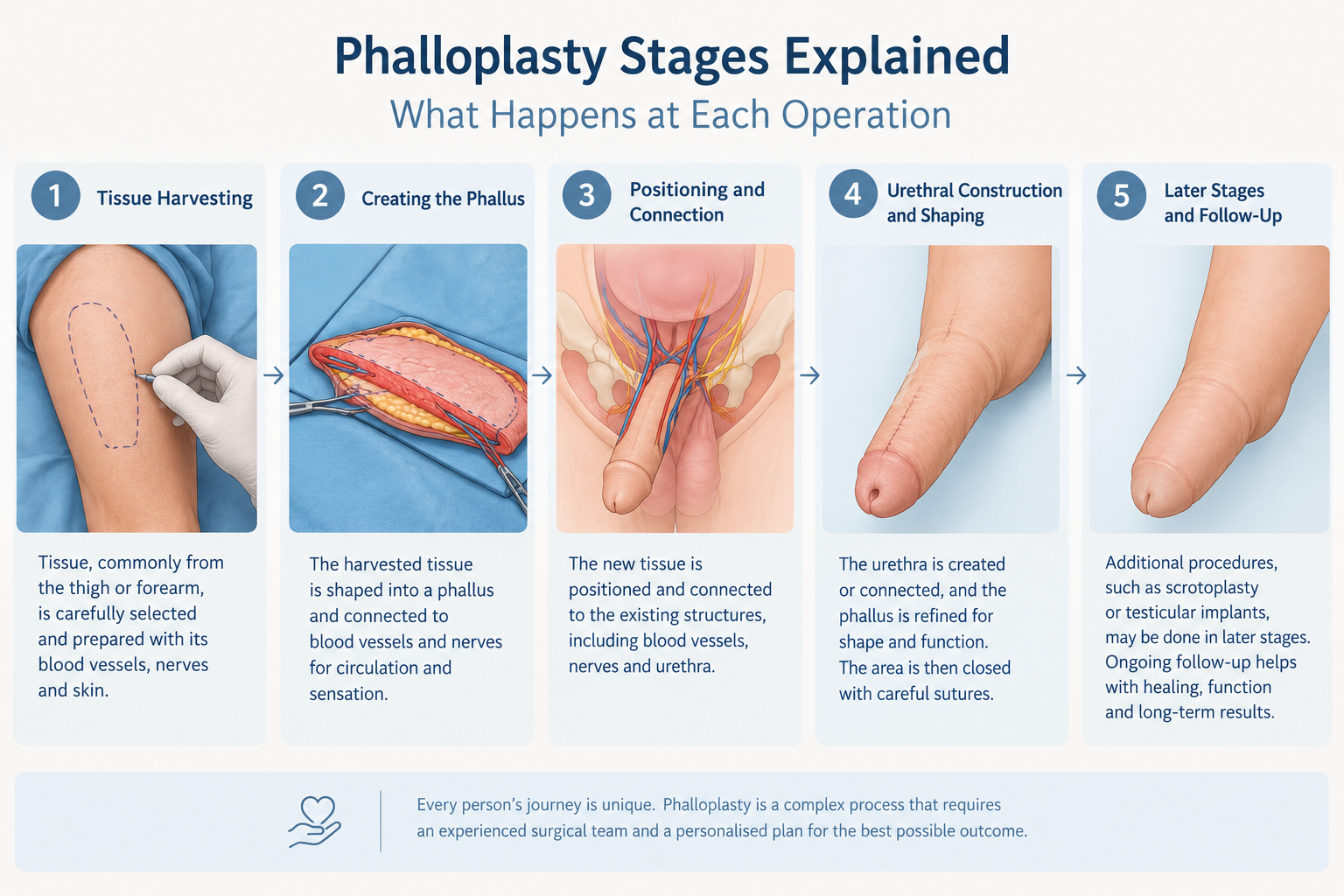
Phalloplasty is usually completed across two to four operations spread over a year or more: the first stage creates the shaft from a flap, and later stages add urethral lengthening, glansplasty and, when chosen, erectile and testicular implants.
Phalloplasty is a complex form of gender-affirming genital surgery. Instead of viewing it as a single operation, it is more useful to understand it as a planned surgical pathway.
The number and sequence of phalloplasty stages vary between surgical teams and patients. Some procedures may be combined, while others are deliberately separated to allow tissues to heal before another reconstruction or implant is added.
Your goals also influence the plan. For example, creating a phallus, achieving standing urination, constructing a scrotum and eventually receiving erectile implants involve different surgical decisions.
What is decided before stage one, including flap choice and urinary goals?
Planning begins well before the first operation.
The surgical team needs to understand what the patient wants the final reconstruction to achieve and whether those goals are medically and technically appropriate.
Important decisions include:
Flap choice
Phalloplasty uses tissue transferred from another part of the body to construct the phallus.
Common donor-site options include the forearm and thigh, although the most appropriate technique depends on individual anatomy, surgical goals and the methods offered by the surgical team.
Each donor site has different considerations involving tissue characteristics, scarring, sensation, blood supply and donor-site recovery.
Urinary goals
One major decision is whether the patient wants urethral lengthening with the goal of urinating while standing.
Urethral reconstruction adds complexity and carries risks such as narrowing or leakage through an abnormal opening. These possibilities should be discussed before surgery.
Standing urination should therefore never be assumed to be part of every phalloplasty.
Scrotal reconstruction
Scrotoplasty may be planned as part of the overall pathway when desired. Testicular implants can then be considered at an appropriate later stage depending on healing and the surgical plan.
Erectile goals
The reconstructed phallus does not automatically become rigid in the same way as erectile tissue.
For patients who want sufficient rigidity for penetrative intercourse, an erectile implant may be considered later after the reconstruction has adequately healed.
Hair removal and donor-site preparation
Some surgical plans require hair removal from specific donor tissue, particularly when that tissue may contribute to urethral reconstruction.
The exact area should be confirmed by the operating team before beginning a prolonged hair-removal programme.
Overall health and surgical readiness
The team may also review general health, medications, smoking or nicotine exposure, previous operations and other factors relevant to anaesthesia and wound healing.
The Genital affirmation referral process can help patients understand the broader preparation pathway.
What does the first stage involve and what does recovery look like?
The first major stage generally focuses on constructing the phallus using the selected flap.
However, there is no universal “stage one” that is identical at every centre. Some teams combine several reconstructive components during the initial operation, while others separate them.
Creating the phallus
Tissue is harvested from the selected donor site and shaped to create the phallus.
When a free flap technique is used, microsurgery connects the flap's blood vessels to recipient vessels so that the transferred tissue receives an adequate blood supply.
What else may happen during stage one?
Depending on the planned technique, the initial operation may also include other components of genital reconstruction.
These can include urethral reconstruction or other procedures, but their timing varies considerably between surgical protocols.
This is an important point when researching how many surgeries phalloplasty needs: the number cannot be predicted simply by counting a standard set of stages.
Early recovery
The first operation is usually a major part of the overall reconstruction.
During the initial recovery period, the surgical team monitors the transferred tissue closely. They also assess the donor site and any additional reconstructed areas.
Hospital stay and recovery time vary according to the procedure, flap technique, associated operations and individual healing.
At Elegance Transgender Clinic, Dr. Ashutosh Shah can discuss the proposed surgical sequence, reconstructive goals and expected recovery according to the individual treatment plan.
Learn more about the Phalloplasty procedure.
Which steps are done at later stages?
Later phalloplasty stages depend on what was completed during the initial surgery and how well the tissues have healed.
Possible later procedures include:
Urethral reconstruction or revision
When standing urination is a goal, urethral lengthening may be incorporated into the reconstruction.
The timing varies by technique. Some components may be performed earlier, while additional reconstruction or revision may occur later.
Urethral complications can also require treatment before moving forward with elective later stages.
Glansplasty
Glansplasty creates additional contour at the end of the reconstructed phallus.
It may be performed during a separate stage after the phallus has healed sufficiently, although surgical protocols differ.
Scrotoplasty
Scrotal reconstruction can form part of the overall genital reconstruction plan.
Its timing depends on the procedures being combined and the surgeon's preferred staging protocol.
Testicular implants
Testicular implants may be considered after the scrotal tissues have healed sufficiently.
Implants should generally not be viewed as something that must be inserted immediately simply to reduce the number of operations.
Erectile implant
An erectile prosthesis may be considered later for patients who want rigidity for penetrative intercourse.
Implant placement is usually delayed until adequate healing has occurred because placing a prosthetic device into recently reconstructed tissue introduces additional considerations, including infection and device-related complications.
How much time is left between stages and why?
There is no single interval that applies to every phalloplasty pathway.
The full process may extend over a year or longer, particularly when multiple operations, healing periods or revisions are required.
Spacing between phalloplasty stages gives reconstructed tissues time to heal and allows the surgical team to identify problems before proceeding.
Why not perform everything at once?
Combining operations may reduce the total number of anaesthetic events, but performing more procedures simultaneously can also increase surgical complexity.
Staging allows the team to assess:
- Flap healing
- Blood supply
- Donor-site recovery
- Urethral healing
- Scarring
- Infection
- Wound healing
- Functional progress
If healing is satisfactory, the next planned operation can proceed when considered appropriate.
If a complication occurs, the timetable may need to change.
Stage-by-Stage Phalloplasty Timeline
| Stage | What May Be Done | Hospital Stay | Recovery | Interval Before Next Stage |
|---|---|---|---|---|
| Pre-operative planning | Flap selection, urinary goals, donor-site preparation and surgical planning | Not applicable | Preparation period varies | Until preparation is complete |
| First major stage | Phallus construction; other procedures may be combined depending on technique | Varies by procedure and centre | Several weeks or longer | Determined by healing |
| Later reconstruction | Urethral work, glansplasty, scrotoplasty or revisions as required | Depends on procedure | Several weeks depending on surgery | Adequate healing before further surgery |
| Implant stage | Testicular and/or erectile implants when selected and appropriate | Depends on procedure | Individualised | Usually after reconstructed tissues are sufficiently healed |
| Revision if required | Treatment of urethral, scar, contour, implant or other complications | Depends on revision | Depends on procedure | Further surgery only after appropriate recovery |
These are general stages rather than a fixed timetable. The exact sequence and hospital stay should come from the treating surgical team.
Which complications are watched for at each stage?
Every operation has its own risks, and the risks change according to what is being performed.
After flap reconstruction
The surgical team pays close attention to blood flow through the transferred tissue.
Problems with arterial inflow or venous drainage can threaten the flap and may require urgent assessment.
Other early concerns include bleeding, infection, wound problems and donor-site complications.
After urethral reconstruction
Two particularly important complications are:
Urethral fistula: An abnormal opening that allows urine to leak somewhere along the reconstructed urinary channel.
Urethral stricture: Narrowing that can make urination difficult or reduce urinary flow.
Not every urinary problem requires the same treatment, and some complications may need time to settle before revision is considered.
After implant surgery
Implant-related risks can include infection, exposure, displacement, mechanical problems and the need for revision or removal.
This is one reason implants are generally considered only after adequate tissue healing.
Donor-site problems
The donor area also requires follow-up.
Scarring, wound-healing problems, changes in sensation and functional issues vary according to the donor site and flap technique.
Forearm versus thigh flap
The choice between a forearm and thigh donor site is more complex than deciding which scar is easier to hide.
| Consideration | Forearm Flap | Thigh Flap |
|---|---|---|
| Donor location | Forearm | Thigh |
| Tissue characteristics | Often thinner tissue | Often thicker tissue |
| Scar location | More visible in everyday clothing for some people | Often easier to cover |
| Suitability | Depends on anatomy, circulation and goals | Depends on anatomy, tissue thickness and goals |
| Urethral planning | Can be suitable for particular reconstructive designs | Technique and suitability vary |
| Final decision | Individual assessment required | Individual assessment required |
The best flap is therefore not universal.
Patients considering alternatives can also read about Metoidioplasty compared.
How does the plan change if a stage does not heal as expected?
A staged reconstruction provides flexibility.
If one operation does not heal as expected, the next elective stage may be postponed.
The immediate priority becomes identifying and managing the problem rather than keeping to the original calendar.
For example, the team may need to address:
- Delayed wound healing
- Infection
- Flap problems
- Urethral fistula
- Urethral narrowing
- Donor-site complications
- Significant scarring
- Other functional concerns
Once the problem has been managed and the tissues are considered ready, the remaining surgical plan can be reassessed.
Does a complication mean the entire reconstruction has failed?
Not necessarily.
Some complications can be managed without abandoning the overall reconstruction. Others may require additional surgery and extend the total treatment timeline.
This is why patients should think of phalloplasty stages as an adaptable treatment pathway rather than fixed appointments that must happen on predetermined dates.
A revised plan may ultimately be safer than proceeding with the next operation before the previous stage has adequately healed.
Patients preparing for surgery can also review information on Booking a surgical consultation.
Conclusion
The number of phalloplasty stages is not identical for every patient. Phalloplasty is usually planned as a sequence in which reconstruction, healing and later functional procedures are coordinated over time.
Flap choice and urinary goals are decided before surgery, while urethral reconstruction, glansplasty, scrotal reconstruction and implants may occur at different points depending on the technique.
Allowing sufficient healing between operations is an important part of the plan. If a complication develops, the next stage may be delayed or modified rather than proceeding according to the original timetable.